common name: wheel bug
scientific name: Arilus cristatus (Linnaeus) (Insecta: Hemiptera: Reduviidae)
Introduction - Synonymy - Distribution - Description and Identification - Life History - Notes on Behavior - Importance as a Predator - Medical Importance - Enemies - Selected References
Introduction (Back to Top)
The wheel bug, Arilus cristatus (Linnaeus), is a moderately common, widely distributed, beneficial assassin bug that preys on pest insects. However, its bite can be more severe than a bee sting, and both nymphs and adults should be avoided or handled with caution.
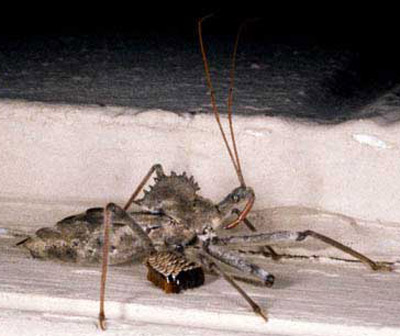
Figure 1. Female wheel bug, Arilus cristatus (Linnaeus), with eggs. Photograph by Donald.W. Hall, University of Florida.
Synonymy (Back to Top)
Wygodzinsky (1949) listed the following synonyms:
Genera:
- Cimex Linnaeus
- Prionotus La Porte
- Prionides Uhler
Species:
- denticulatus Westwood
- novenarius (Say)
- patulus (Walker)
Distribution (Back to Top)
The wheel bug occurs throughout Florida. It has been reported from Rhode Island west to California, and south to Texas and Florida. Blatchley (1926) included Mexico and Guatemala in its range. Wygodzinsky (1949) recognized four species of Arilus in this New World genus, but only cristatus occurs in the United States.
Description and Identification (Back to Top)
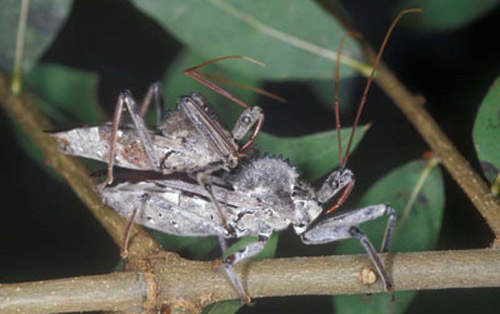
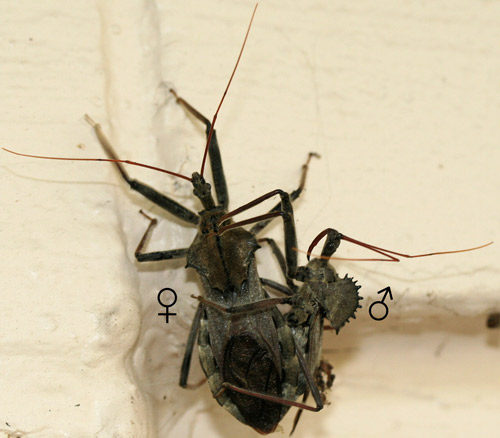
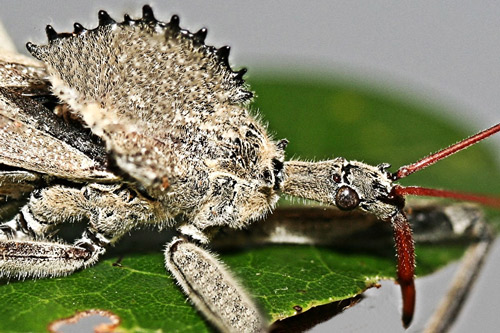
Adult: The wheel bug adult usually measures from 1 to 1.25 inches long. This assassin bug is a dark, robust creature with long legs and antennae, a stout beak, large eyes on a slim head, and a prominent thoracic, semicircular crest that resembles a cogwheel or chicken's comb. This is the only insect species in the United States with such a crest. The number of teeth (tubercles) in the crest varies from eight to 12. Females are larger than males, with the abdominal margins being more widely exposed in the females. A very fine yellowish pubescence is present over most of the body, except the hemelytral membrane which is iridescent bronze. The overall color is dark brown. Variable amounts of tiny white patches or granules are scattered throughout the pubescence.
Figure 2. Adult wheel bugs, Arilus cristatus (Linnaeus). Photograph by Lyle J. Buss, University of Florida.
Figure 3. Adult wheel bugs, Arilus cristatus (Linnaeus), mating. Photograph by Donald W. Hall, University of Florida.
Figure 4. Close-up of head, pronotum and "wheel" of the wheel bug, Arilus cristatus (Linnaeus). Photograph by Donald W. Hall, University of Florida.
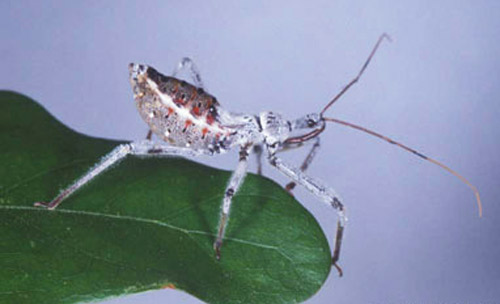
Nymphs:Nymphs have been described in detail by Readio (1927). Smaller nymphs are bright red with black marks. The last instar nymphs are darker. Nymphs lack the "wheel" or crest. For a diagnostic key to identify nymphs of the family Reduviidae to genus (including Arilus), see Fracker and Usinger (1949).
Figure 5. A nymph of the wheel bug, Arilus cristatus (Linnaeus). Photograph by Lyle J. Buss, University of Florida.
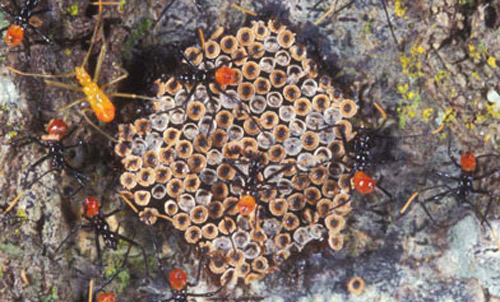
Eggs: Eggs resemble miniature brown bottles with white stoppers. They are 3.7 mm long and are laid on end, side by side, in a compact hexagonal cluster of 42 to 182 eggs. The cluster is glued together and covered by gummy cement that may protect the eggs from foul weather, parasites, and predators. Egg clusters are typically found at a height of 4 feet or below on tree trunks and limbs, shrubs, and miscellaneous objects.
Figure 6. Eggs and early instar nymphs of the wheel bug, Arilus cristatus (Linnaeus). Photograph by Lyle J. Buss, University of Florida.
Life History (Back to Top)
The wheel bug has one generation a year and overwinters in the egg stage. In Florida some adults live into the winter months, particularly in the central and southern portions of the state. Of approximately 60 Florida wheel bug records available to the author, nymphs were recorded from 22 April to 15 June, with most occurring in May. The limitation of nymphal records to springtime is good evidence for only one generation a year. It seems likely that nymphs are present in March, but have not been recognized and reported until they are much larger in late April. According to Todd (1937), development from egg to adult takes about three months (at Clemson, SC). This developmental time would account for new generation adults not being reported in Florida until late May, assuming hatching occurred approximately the first of March. Based on available records, June and July are the peak months for reports of adults in Florida. Reports drop off beginning in August, with very few in September and October, then increase again in November, with records throughout the peninsula. This suggests some aestivation (dormancy due to hot or dry conditions) during late summer and early fall. These late fall adults are mostly gravid females.
A wheel bug caught at Gainesville during December 1973 and brought into the lab, laid eggs shortly thereafter (R.I. Sailer, personal communication). Todd (1937) measured the developmental time for nymphs in outdoor cages at Clemson, SC. Average time for each of the five nymphal instars was listed as follows: I-21 days, II-14 days, III-15 days, IV-17 days, and V-32 days, totaling 99 days. Moul (1945) reported some life history information of the wheel bug at York County, PA, and provided a detailed list of prey. Stehr and Farrell (1936) reported that a caged, late-instar wheel bug nymph consumed 69 adults and 22 large larvae of the Mexican bean beetle, Epilachna varivestis Mulsant, in 28 days. Some of the favored habitats of wheel bugs include cotton, goldenrod, sunflower, and other flowers, trunks of locust trees, citrus and pecan groves, and miscellaneous forest, shade, and fruit trees.
Notes on Behavior (Back to Top)
Todd (1937) reported the wheel bug under natural conditions as being very aggressive in the nymphal and adult stages of development. This aggressiveness was not so pronounced in individuals under observation in cages. He noted that specimens collected in the field became accustomed to being handled in a very short time. The wheel bug has also been reported as cannibalistic, usually based on caged specimens. Nymphs have preyed upon nymphs, and Barber (1920) reported females killing and feeding upon the males soon after copulation was complete. The wheel bug is diurnal but it has been found at lights, apparently attracted to the prey coming to the lights. Froeschner (1944) counted 76 wheel bugs at one time at lights in front of a store in southern Missouri.
Sounds: The wheel bug and most other reduviids produce "chirping" sounds by rubbing the tip of the rostrum back and forth over transverse ridges on a longitudinal groove on the prosternum. Moore (1961) concluded that more evidence is necessary to establish the functions of these sounds.
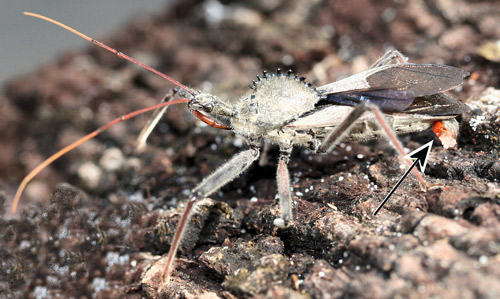
Scent sacs: Garman (1916) and Froeschner (1944) noted that wheel bugs, when captured, extrude (with little provocation) a pair of bright, orange-red scent sacs near the apex of the venter (subrectal glands) (Figure 7). These subrectal glands were once thought to give off a pungent scent when the bugs are disturbed. However, subrectal glands are found only on females and their scent is described as pleasant (Aldrich et al. 2013). The pungent scent is now known to originate instead from Brindley’s glands (Aldrich et al. 2013) that are found on the metathorax (Gordh & Headrick 2001). Aldrich et al. have suggested that because the subrectal glands are female specific, they may have a sexual function.
Brindley’s gland secretions are believed to be defensive (Staddon 1979). The secretion of Brindley’s gland is a blend of 2-methylpropanoic, butanoic, 2-methylbutanoic, and 3-methylbutanoic acids ((Aldrich et al. 2013).
Figure 7. Adult female wheel bug, Arilus cristatus (Linnaeus), showing orange-red subrectal glands (arrow). Photograph by Donald W. Hall, University of Florida.
Attractant: Metzger (1928) reported that wheel bugs were strongly attracted to turpentine oil.
Importance as a Predator (Back to Top)
The wheel bug has been reported preying upon a wide variety of insects in several orders including Lepidoptera, especially Arctiidae and Noctuidae; Coleoptera, especially Chrysomelidae and Coccinellidae; Hemiptera, especially Pentatomidae; Hymenoptera, especially sawflies; and Homoptera, especially aphids upon which young nymphs feed. Unfortunately, the above groups include the beneficial lady beetles and honey bees. The wheel bug is one of the few predators that attack the brown marmorated stink bug, Halyomorpha halys Stål (Hemiptera: Pentatomidae) (Aldrich et al. 2013), a serious introduced pest of many crop plants and also a household pest when it congregates indoors to overwinter.
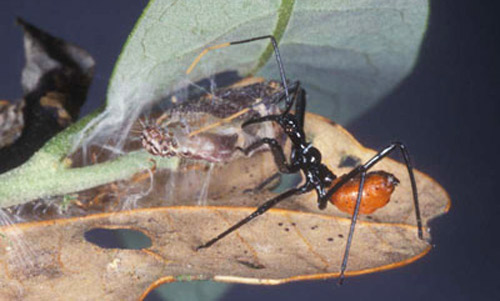
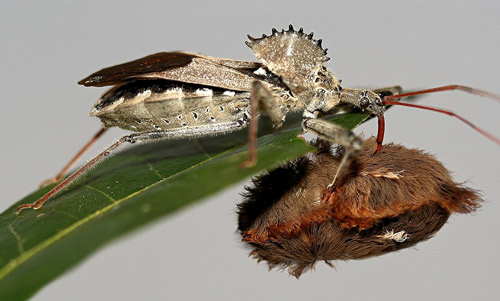
Immatures of the locust leafminer, Xenochalepus dorsalis (Thunberg), are killed and fed upon while still imbedded in leaf tissue. Arilus cristatus is an especially valuable predator in forest and shade trees because it preys on the well-protected hairy caterpillars that are defoliators (Figures 8 and 9).
Figure 8. A nymph of the wheel bug, Arilus cristatus (Linnaeus), feeding on a caterpillar. Photograph by Lyle J. Buss, University of Florida.
Figure 9. Adult wheel bug, Arilus cristatus (Linnaeus), feeding on a puss caterpillar, Megalopyge opercularis (Smith). Photograph by Donald W. Hall, University of Florida.
Wheel bug saliva contains a toxic, paralytic substance that immobilizes and kills the prey insect within 15 to 30 seconds of injection.
Medical Importance (Back to Top)
When disturbed, the wheel bug can inflict a painful bite. The bite has been described variously as worse than stings from bees, wasps, or hornets. Barber (1919) and Hall (1924) described in detail the effects of such bites. In general, initial pain often is followed by numbness for several days. The afflicted area often becomes reddened and hot to the touch, but later may become white and hardened at the puncture area. Occasionally, a hard core may slough off, leaving a small hole at the puncture site. Healing time varies but usually takes two weeks. Smith et al. (1958) reviewed the literature concerning wheel bug bites and concluded that serious or prolonged effects from these bites usually are due to secondary infection or an individual hypersensitivity.
Enemies (Back to Top)
There are at least three hymenopterous egg parasitoids of Arilus cristatus:
- Anastatus reduvii (Howard) (Eupelmidae) (Hagerty & McPherson 2000, Peck 1963, Swadener & Yonke 1973)
- Ooencyrtus johnsoni (Howard) (Encyrtidae) (Hagerty & McPherson 2000, Peck 1963)
- Ooencyrtus clisiocampae (Ashmead) (Encyrtidae) (Swadener & Yonke 1973)
Selected References (Back to Top)
- Aldrich JR, Kamlesh R. Chauhan KR, Zhang A, Zarbin PHG. 2013. Exocrine secretions of wheel bugs (Heteroptera: Reduviidae: Arilus spp.): Clarification and chemistry. Zeitschrift für Naturforschung (Section C. Biosciences) 68: 522-526.
- Barber GW. 1919. On the bite of Arilus cristatus. Journal of Economic Entomology 12: 466.
- Barber GW. 1920. Notes on the oviposition and food of the wheel-bug (Arilus cristatus Linn.) (Hemip. Heter.). Entomological News 31: 107.
- Blatchley WS. 1926. Heteroptera or true bugs of eastern North America, with especial reference to the faunas of Indiana and Florida. Nature Publishing Company, Indianapolis, IN. 1116 pp.
- Fracker SB, Usinger RL. 1949. The generic identification of Nearctic reduviid nymphs (Hemiptera). Annals of the Entomological Society of America 42: 273-278.
- Froeschner RC. 1944. Contributions to a synopsis of the Hemiptera of Missouri, Pt. III. American Midland Naturalist 31: 638-683.
- Garman H. 1916. The locust borer (Cyllene robiniae) and other insect enemies of the black locust. Kentucky Agricultural Experiment Station Bulletin 200: 99-135.
- Gordh G, Headrick DH. 2001. A Dictionary of Entomology. CABI Publishing. New York. 1032 pp.
- Hagerty AM, McPherson JE. 2000. Life history and laboratory rearing of Arilus cristatus (Heteroptera: Reduviidae) in southern Illinois. The Florida Entomologist 83: 58-63.
- Hall MC. 1924. Lesions due to the bite of the wheel-bug, Arilus cristatus (Hemiptera; Reduviidae). Journal of the Washington Academy of Science 14: 204.
- Metzger FW. 1928. Turpentine oil as an attractant of the wheel bug (Arilus cristatus L.). Journal of Economic Entomology 21: 431-432.
- Moore TE. 1961. Audiospectrographic analysis of sounds of Hemiptera and Homoptera. Annals of the Entomological Society of America 54: 273-291.
- Moul ET. 1945. Notes on Arilus cristatus (Linnaeus) in York County, Pennsylvania and on its prey (Heteroptera: Reduviidae). Entomological News 56: 57-59.
- Peck O. 1963. A catalogue of the Nearctic Chalcidoidea (Insecta: Hymenoptera). Canadian Entomologist Supplement: 1-1092.
- Readio PA. 1927. Biology of the Reduviidae of America north of Mexico. Kansas University Science Bulletin 17: 1-291.
- Smith FD, Miller NG, Carnazzo SJ, Eaton WB. 1958. Insect bite by Arilus cristatus, a North American reduviid. Archives of Dermatology 77: 324-333.
- Stehr WC, Farrell W. 1936. Two hemipterous enemies of the Mexican bean beetle in Ohio. Ohio Journal of Science 36: 332-333.
- Swadener SO, Yonke TR. 1973. Immature stages and biology of Sinea complexa with notes on four additional reduviids (Hemiptera: Reduviidae). Journal of the Kansas Entomological Society. 46: 123-136.
- Todd JN. 1937. Life history of the wheel-bug, Arilus cristatus (Linn.) (Hemiptera: Reduviidae). Entomological News 48: 226-228.
- Wygodzinsky P. 1949. Elenco sistematico de los Reduviiformes Americanos. Univ. Nac. Tucuman, Inst. Med. Reg. (Pub. No. 473), Monograph No. 1: 1-102.