common name: lesser canna leafroller
scientific name: Geshna cannalis (Quaintance) (Insecta: Lepidoptera: Crambidae)
Introduction - Distribution - Description and Life History - Hosts and Damage - Management - Selected References
Introduction (Back to Top)
The lesser canna leafroller, Geshna cannalis (Quaintance), can be a serious pest of ornamental canna, Canna spp., in Florida. It is one of two leaf-rolling lepidopteran species found infesting canna, the other one being the larger and more voracious larger canna leafroller, Calpodes ethlius (Stoll). Cannas may be infested with both species simultaneously.
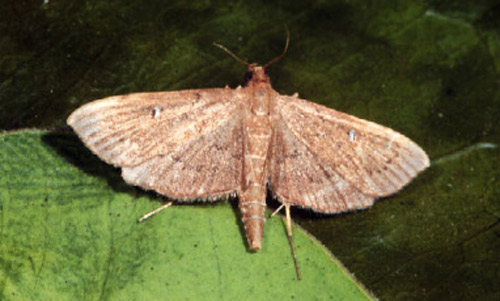
Figure 1. Adult lesser canna leafroller, Geshna cannalis (Quaintance). Photograph by Paul M. Choate, University of Florida.
Distribution (Back to Top)
Very little is known about the distribution of Geshna cannalis but it appears to be distributed throughout the southeastern United States. It has been recorded as a pest of canna in Florida (Kimball 1965), Texas, Louisiana, Tennessee, and South Carolinasee Butterflies and Moths of North America. Since Geshna cannalis is a specialized pest of canna, which originated in the American tropics, it is likely that this insect species is also present in the Neotropics.
Description and Life History (Back to Top)
Adult Geshna cannalis are nondescript, small, light-brown crambid moths which may be found resting in the shade of a canna plant during the day. The female wing span averages 25 mm (Quaintance 1898). There are two brownish black lines across the fore- and hindwings, and a small angular white patch near the distal portion of the discal cell of the forewing. Females lay eggs in groups of six to 15 on the upper surface of a canna leaf (Quaintance 1898). Eggs are flat, clear whitish yellow in color, and average 0.9 mm in size.
The first instars hatch and feed as leaf miners, tunneling between the upper and lower epidermis and excreting much frass into the tunnel. This first larval instar measures 1.4 mm in length and has a yellowish, somewhat transparent body, and a yellow head. After larvae become too large for their leaf mines, they feed gregariously on the upper leaf surface. When larvae are approximately one week old, they initiate leaf-rolling behavior. Five or six larvae may be found within a leaf roll, but usually only one or two coexist.
Figure 2. Rolled canna leaf showing feeding injury typical of the lesser canna leafroller, Geshna cannalis (Quaintance). Photograph by Paul M. Choate, University of Florida.
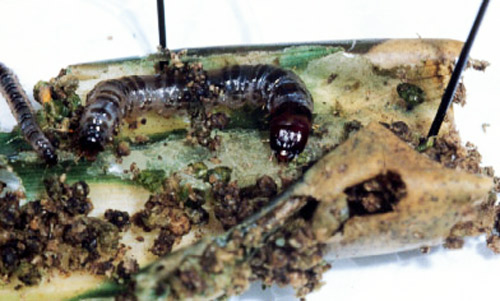
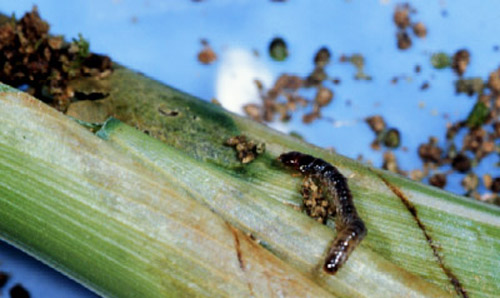
The last instar larva is about 23 mm in length and is yellowish white. Its body is transparent and the green color of its food is plainly visible through the integument. The head is yellow, with the clypeus yellowish brown and the tips of the mandibles brownish-black. The last instar larva spins a silken shelter within its leaf roll and pupates within the shelter. The pupa is 11.5 mm in length and is chocolate brown in color. There are eight stout dark brown hairs shaped into hooks on the caudal end of the pupa which hold the pupa in the silken shelter.
Figure 3. Late instar larva of the lesser canna leafroller, Geshna cannalis (Quaintance). Photograph by Paul M. Choate, University of Florida.
The pupal stage of the final generation of the year overwinters in dead canna leaves. Adult moths are usually first seen in late February and early March in Florida (Quaintance 1898). The first generation lasts 35 days while later generations during the summer are probably as short as 28 or 30 days. During the summer, the generations overlap and insects at all developmental stages can be found in the same canna planting.
Hosts and Damage (Back to Top)
Geshna cannalis appears to be restricted to feeding on various species of canna. Its feeding damage can be readily distinguished from that of C. ethlius, the larger canna leafroller. Calpodes ethlius rolls up the edge of a fully expanded leaf and uses silk to hold the edges closed. Geshna cannalis may also feed this way, but it more frequently feeds within leaves that have not yet expanded (Quaintance 1898). It ties the unfurled leaf together with silk, preventing further expansion. Calpodes ethlius eats through the entire leaf surface whereas Geshna cannalis eats only the upper epidermis and parenchyma (the inner surface of the leaf roll), leaving the lower epidermis intact (Quaintance 1898). Finally, C. ethlius flicks away its frass so that the leaf roll is frass-free, whereas the feeding shelter of Geshna cannalis contains much dark brown frass.
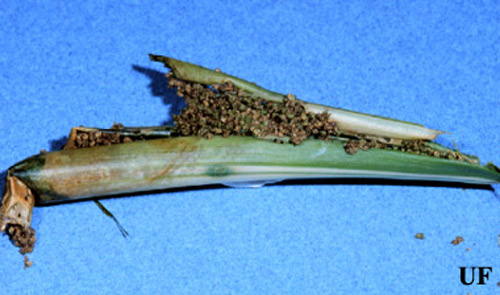
Figure 4. Frass-filled canna leaf roll containing larvae of the lesser canna leafroller, Geshna cannalis (Quaintance). Photograph by Paul M. Choate, University of Florida.
Management (Back to Top)
Cutting dead canna plants to the ground in the late winter is a good way to reduce populations of Geshna cannalis. Disposing of the cut material with the overwintering pupae will reduce initial population levels of this insect in the spring. During larval infestation in the summer, insecticides can be sprayed into the leaf roll, however, stickers must be added because the very waxy canna leaf surface repels water. Products that contain Bacillus thuringiensis (Bt) are least toxic to beneficial organisms.
Selected References (Back to Top)
- Baker JR. Insect and related pests of flowers and foliage plants: some important, common, and potential pests in the southeastern United States. North Carolina State University. http://ipmwww.ncsu.edu/INSECT_ID/AG136/ncstate.html (26 May 2017)
- Kimball CP. 1965. The Lepidoptera of Florida: An annotated checklist. Division of Plant Industry, State of Florida Department of Agriculture, Gainesville, Florida.
- Lotts, Kelly and Thomas Naberhaus, coordinators. 2016. Butterflies and Moths of North America. http://www.butterfliesandmoths.org/ (Version 05092017).
- Quaintance AL. 1898. Three injurious insects: bean leaf-roller, corn delphax, canna leaf-roller. Florida Agricultural Experiment Station Bulletin 45: 53-74.